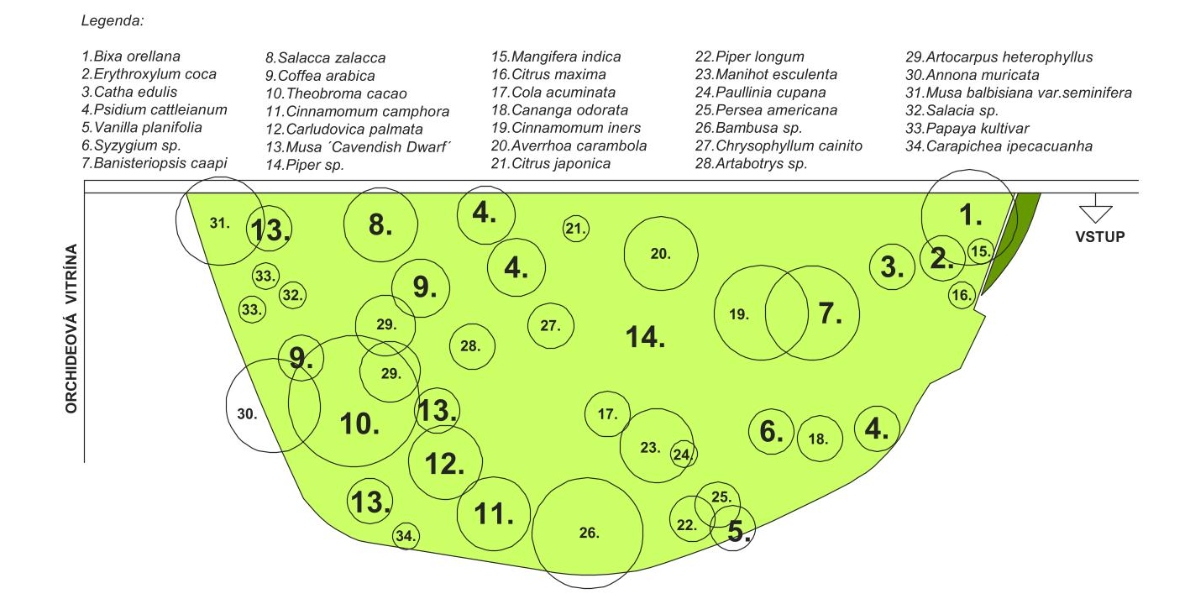
Dye-tree, Bixa orellana, tropical America. The red seeds are used in the food industry; indigenous peoples use them to decorate their bodies (they repel mosquitoes); after oxidation, they turn a purplish-black color, and the Aztecs used them as ink.
Coca tree, Erythroxylum coca, tropical America. The leaves contain cocaine, and indigenous peoples chew them together with burnt lime. They act as a medicine and help alleviate altitude sickness. It is abused as a drug.
Kata, Catha edulis, Northeast Africa. Chewing the shoots is more of a social ritual with a mildly stimulating effect, but it is addictive.
Guava, Psidium cattleyanum, Brazil. It produces tasty fruit.
Vanilla, Vanilla planifolia, Mexico. An orchid-like vine whose fruits, pods, are known as a culinary spice. Today it is cultivated in many tropical regions; the best is said to come from Hawaii, Réunion, and Madagascar.
Clove tree, Syzygium, is a myrtle-like shrub whose approximately 1,200 species inhabit the tropics of the Old World, primarily Southeast Asia. The dried flower buds of the fragrant clove tree (S. aromaticum), native to the Moluccas, are a well-known spice—cloves.
ayahuasca, yagé, Banisteriopsis caapi, South America. It is a sturdy vine called the “Vine of Souls or Death.” It is among the most potent hallucinogens; rituals must always be led by an experienced shaman.
Edible salak, Salacca zalacca, Java and Sumatra. Today it is cultivated throughout Southeast Asia. It produces a tasty and long-lasting fruit with a unique scaly skin, for which it is commonly called “snake egg.”
Arabica coffee tree, Coffea arabica, northeastern Africa. The fruit is a berry; the roasted seeds are the basis of the popular beverage—coffee.
Cacao tree, Theobroma cacao, tropical America. A cauliflorous (flowering on the trunk and branches) shrub or small tree. The fruits are berries with seeds that germinate quickly. These are roasted and form the basis for chocolate production.
Camphor tree, Cinnamomum camphora, southern China, Taiwan, and Japan. It belongs to the laurel family and the same genus as the cinnamon tree. True camphor, used primarily in medicine, is obtained by distilling the wood, leaves, and roots.
Carludovica palmata, Ecuador. Its appearance is deceptive; it is not a palm tree. Its leaves are used to make authentic Panama hats.
Banana tree – Acuminata hybrid, Musa ‘Cavendish Dwarf’ is one of the shortest cultivated banana trees. It can still be found in various parts of the world today and played a particularly important role in the Canary Islands.
Black pepper, Piper nigrum, southern India. In its native habitat, it is grown on structures in pyramids up to 4 m high. The fruit consists of the well-known berries. Black pepper is the most common form, consisting of dried whole berries; after grinding the pericarp, we obtain white pepper. Red pepper comes from the fruit of the unrelated South American tree Schinus molle (pink pepper).
Indian mango, Mangifera indica, Himalayan foothills. The cultivar we grow bears fruit even at a height of 2 meters. Today it is cultivated in the tropics around the world.
Pomelo, Citrus maxima, Southeast Asia, possibly also from Malaysia. On plantations in the Caribbean, it became one of the parents of the grapefruit.
Spear-leaved cola, Cola acuminata, West Africa. Muslims consider the seeds sacred; in Africa, they were used as currency. They contain mainly starch, theobromine, caffeine, tannins, essential oils, and a dye called cola red.
Ylang-ylang, Cananga odorata, tropical Asia and Australia. The wonderfully fragrant flowers are a source of essential oil used in cosmetics, aromatherapy, and medicine.
Carambola, Averrhoa carambola, Southeast Asia. It is a small, cross-pollinated tree of the oxalid family. It is cultivated for its juicy, sweet-and-sour fruit.
Kumquat, Citrus japonica, is a large shrub native, despite its name, to China and Vietnam. It is grown both as an ornamental plant and for its slightly bitter fruit.
Long pepper, Piper longum, India and the foothills of the Himalayas. It is a dioecious vine. The berries, which have a sharper flavor than common pepper, are particularly popular in Indian cuisine. It also has a place in Ayurvedic medicine.
Cassava, Manihot esculenta, South America. It is a fast-growing subshrub of the Euphorbiaceae family. It has massive tuberous roots containing starch. It is poisonous when raw, so it is dried or cooked. Today, it provides food for nearly half a billion people.
guarana, Paullinia cupana, Venezuela and Brazil. The seeds are used as a stimulant. They improve memory, reduce hunger, alleviate pain, and also act as an aphrodisiac. In Brazil, it is used to make a variety of lemonades; in our country, Amazonia lemonade was once sold.
Avocado, Persea americana, is an evergreen tree native to central Mexico. The oval berry contains a large seed and a buttery mesocarp rich in unsaturated fatty acids with high nutritional value. It is the basis of guacamole, a staple of Mexican cuisine.
Bamboo, Bambusa sp., Southeast Asia to northeastern Australia. It is used primarily as a building material. Bamboo shoots are added to traditional dishes throughout Southeast Asia.
Golden-leaf tree, Chrysophyllum ainito, the Antilles. It is cultivated for its seasonal sweet fruit; an infusion made from the leaves is used to treat diabetes and rheumatism.
Artabotrys sp., India. Cultivated exclusively for its fragrant flowers.
Breadfruit tree, Artocarpus heterophyllus, India. An evergreen, monoecious tree that grows up to 30 m tall. All parts of the plant have medicinal properties. The giant fruits and flowers are used in various culinary preparations.
Soursop, Annona muricata, the Caribbean, Central, and northern South America. It is cauliflorous; the drupes fuse into a false fruit up to 30 cm long with soft spines and very tasty white flesh. In Mexico, sorbet made from soursop and ice is very popular.
Banana tree, Musa balbisiana, from Sri Lanka to China. It grows up to 6 meters tall, with leaves up to 3 meters long. The gray-green berries, just under 15 cm long, are full of seeds.
Salacia sp., India and Sri Lanka. This climbing plant is used primarily in Ayurvedic medicine.
Papaya cultivar, Central America. A tropical fruit popular even here.
Ipecacuanha, Carapichea ipecacuanha, South America. A slow-growing, low shrub. In the 17th century, an emetic (Ipecac syrup) was produced from the plant’s root. It was also administered for dysentery. Today, it is no longer used as a medicinal plant.